

Odoo pricing explained
Odoo's pricing looks simple on the website: per user per month, plus a few options. The reality is more nuanced. Line by line, this guide breaks down where the money actually goes — licences, implementation, hosting, integrations, hypercare and the optional extras nobody warns you about — so you can budget honestly and avoid the surprises that sour the second year.
The Odoo licence is rarely the biggest line in your budget. Implementation almost always is, and it's where the real differences between offers live. Two partners can quote you the same number for very different products.
We'll walk you through the real cost categories, the ranges that are typical on the Belgian market, and the questions that surface what actually drives your invoice — not the brochure number.
Licence cost — the easy bit, with one trap
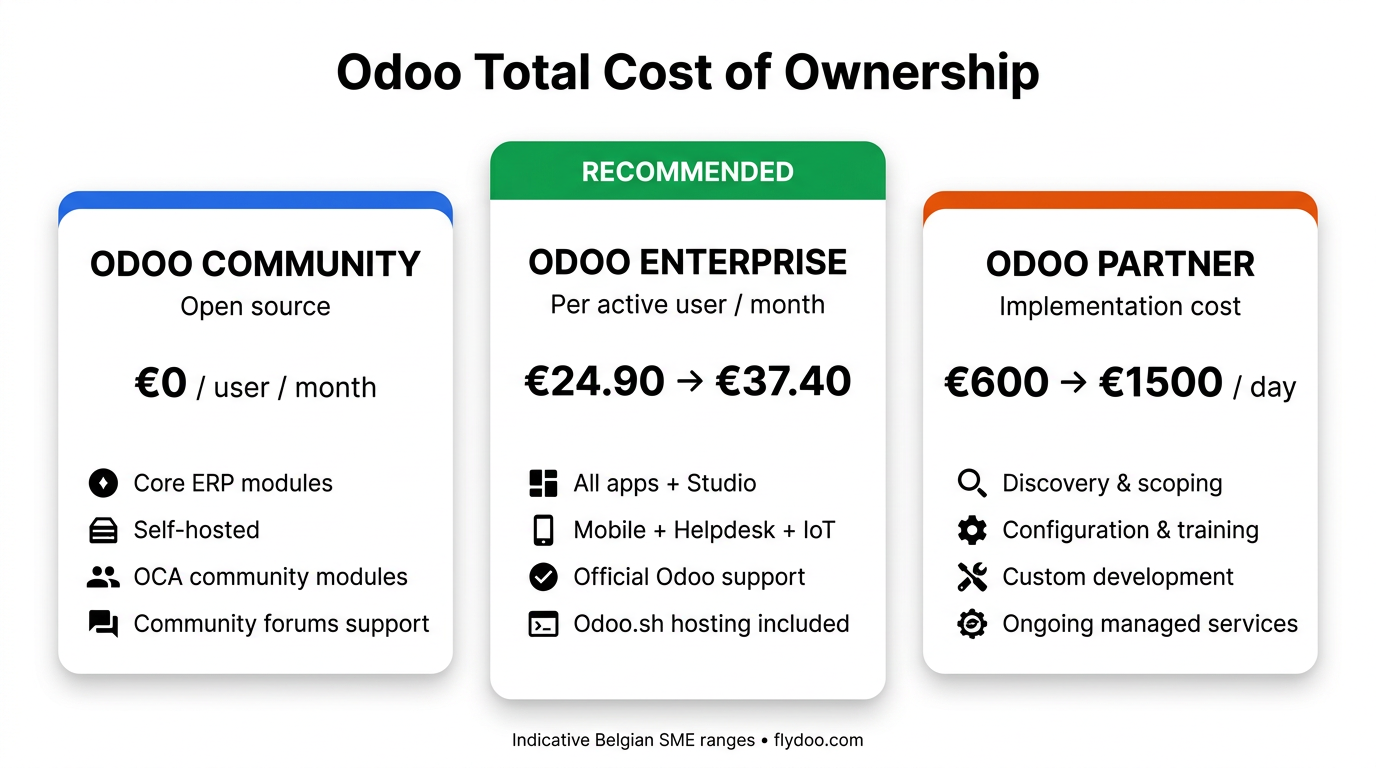
Odoo Enterprise is sold per user per month, with one published list price and a small number of variations (Standard / Custom / Online). For most SMEs in Belgium, the all-in licence cost lands around €20-40 per user/month after Belgian VAT and any partner reseller margin. There's no per-module charge in the modern packaging — it's all-or-nothing on Enterprise apps.
The trap: 'user' counts. Internal employees who log in are billable. External portal users (your customers checking quotations) are free. Read-only or occasional users are still billable. Budgets balloon late in the process when an HR team discovers that every shop floor employee with a payroll login counts as a full user — count the logins before you sign, not after.
- List price ~€30/user/month for Standard, slightly more for Custom
- Annual contracts get a discount; multi-year contracts more so
- Portal users (customers, vendors) are free — use them where possible
- Community is €0 in licence, but you lose the polished modules + support
- Resellers (partners) get margin — list price is your ceiling, not a fixed
Implementation cost — where partners differ wildly
Implementation is the line that varies most between partners and where discipline pays off. Typical SME projects in Belgium run €40k-€150k for a 5-8 module scope, executed over 4-6 months. Larger or more complex scopes (manufacturing, multi-company, heavy migrations) push easily to €150k-€350k. Below €30k for anything serious is a yellow flag.
What drives the number isn't the modules — it's the data, the integrations, the customisations and how many real workshops you'll actually run. We always quote in named lines so you can compare; anyone giving you a single 'package' number is hiding either margin or risk.
- Discovery + scoping: €5-15k, often delivered as a fixed pilot
- Configuration + workshops: typically half of the total budget
- Custom development: priced per module/feature, ranges €5-50k each
- Data migration: €10-40k depending on quality and volume
- Integrations (PIM, e-commerce, banking, EDI): €5-30k each
Hosting cost — Odoo Online, Odoo.sh, or your own infra
Hosting is the third significant line. Odoo Online is the cheapest option (included in some Standard contracts) but limits customisation to Studio. Odoo.sh is the pragmatic default as soon as custom modules are in play — it's around €40-150/month for an SME instance, scales with usage, and gives you Git-based deployments. Self-hosting is doable on Community but adds DevOps load.
Our default for Belgian SMEs deploying Enterprise: Odoo.sh on the EU region. It's predictable, ISO 27001 certified, and avoids the cost of managing your own Linux + PostgreSQL + reverse proxy stack. The €100/month is dwarfed by what one weekend of self-hosted firefighting would cost.
- Odoo Online: simplest, cheapest, no custom modules — only Studio
- Odoo.sh: ~€40-150/month for SMEs, custom modules supported
- Self-hosted: lowest licence cost, highest DevOps cost — needs real ops capacity
- EU regions available for GDPR alignment — verify on your contract
- Sandbox / staging environments cost extra on Odoo.sh, but they're worth it
Hypercare and support — the line everyone underestimates
Hypercare is the 6-12 weeks after go-live where you fix the things you couldn't predict in UAT. It's distinct from BAU support, and it's where a serious partner shines or disappears. Budget €15-40k for hypercare on a typical SME project — separately, named, in the quote. After hypercare, ongoing BAU support runs €1-5k/month depending on depth.
Skipping hypercare is the single most common false economy in Odoo projects. The bugs and process gaps that surface in week 3 of live operation will kill team trust if there's no one to fix them inside 48 hours. Pay for hypercare. Demand it as a named line.
- Hypercare: 6-12 weeks post go-live, €15-40k for an SME project
- BAU support: €1-5k/month, scales with usage and ticket volume
- Continuous improvement: budget 10-20% of project cost annually
- Upgrades to new yearly versions: €5-25k depending on custom load
- Avoid retainers that bundle everything — granularity protects you
Total cost of ownership — what to budget for year 1 and beyond
For a typical 30-50 user SME in Belgium implementing 5-8 Odoo modules, market rates put year 1 (implementation + licences + hosting + hypercare) in the tens of thousands, with a smaller recurring figure for licences, hosting and ongoing improvements. Ranges vary widely by scope and partner — treat any number you are given, including these, as something to validate against your own scope. Flydoo publishes fixed-scope package prices for small-business implementations.
Anyone telling you year-1 will cost €25k for a real production deployment is either selling Community with very limited scope or setting you up for change orders. Honesty about TCO is a partner selection criterion in itself.
- Year 1: implementation + licences + hosting + hypercare = €80-200k for typical SME
- Year 2+: licences + hosting + BAU + continuous improvement = €30-70k/year
- Custom development becomes a recurring line if you let it — keep it under control
- Plan for major version upgrades every 2-3 years — budget €5-25k per upgrade
- ROI for SMEs typically shows up in 12-24 months — measure it, don't assume it
Pricing mistakes that quietly wreck budgets
These are the patterns that make Odoo look expensive when it shouldn't.
- Comparing licence price only — implementation is the bigger number, ignore it at your peril.
- Skipping hypercare to save €20k — and spending €60k of internal time firefighting in month 2.
- Buying user seats for everyone 'just in case' — start lean, add seats when needed.
- Believing the cheapest quote — it almost always becomes the most expensive via change orders.
- Ignoring continuous improvement budget — Odoo is a platform, not a one-shot project.
How to measure if your Odoo budget is working
These are the markers we look for after year 1 to confirm pricing was honest.
- Project cost landed within +/-15% of the original quote (anything wider hides scope drift or sandbagging).
- Hypercare ticket volume dropped 70%+ between week 2 and week 12 post go-live.
- BAU support cost stable, not creeping up month over month.
- Custom code share stayed under 15% of total — a key cost predictor for upgrades.
- Annual TCO predictable within 10% — surprises are a partner-quality signal.
How we quote at Flydoo
We quote in named lines, with assumptions written down, in ranges where honest uncertainty exists. Discovery is fixed-price (so you know what the first deliverable costs); configuration and customisation are time-and-materials with capped sprints; hypercare is a separate, named line. We won't bundle everything into one mystery number.
We also tell you what we won't do — the modules we don't recommend, the integrations we'd defer to phase 2, the customisations that smell wrong. If a partner is happy to quote everything you ask for without pushback, they're billing you for the privilege.
- Quotes broken into named lines: discovery, config, dev, migration, integrations, hypercare, PM
- Estimates as ranges with named uncertainty drivers, not a single fake number
- Discovery as a fixed-price first deliverable — you can stop here if the fit isn't right
- Hypercare always quoted separately, never bundled into 'support'
- Honest 'don't do this' recommendations included in every proposal
Pricing checklist before you sign
Tick most of these. If you can't, ask the partner why.
- Quote is in named lines, not a single 'package' number
- User count is realistic for year 1 — not padded 'just in case'
- Hypercare is a separate, named, dated line — not 'included in support'
- Hosting choice (Online / Odoo.sh / self-hosted) is justified, not just defaulted
- Migration scope is sized against actual data volume and quality
- Integrations are quoted per integration with named scope, not as a lump
- Year 2 ongoing TCO is named in the proposal — partners who avoid this are hiding something
Key takeaways
- Licence cost is rarely the biggest line — implementation almost always is
- Typical Belgian SME year-1 budget: €80-200k all-in for 5-8 modules
- Hypercare is non-negotiable — €15-40k, named separately, never bundled
- Demand quotes in named lines with assumptions written down
- TCO predictability is a partner-quality signal — surprises mean weak scoping
Frequently asked questions
How much does Odoo really cost for a 30-person company?
All-in for year 1 in Belgium: typically €80-150k. That breaks down roughly as €40-90k implementation, €10-15k Enterprise licences (30 users × ~€30/month × 12), €1-2k hosting on Odoo.sh, and €15-30k hypercare. Year 2 onwards drops to €30-50k/year for licences, hosting and continuous improvement. These are honest mid-range numbers — your partner should be able to defend each line.
Why do partner quotes vary so much for the same scope?
Three real reasons: seniority of the team they'll actually staff (a senior consultant costs more but delivers 2-3x faster than a junior), how much custom they're already planning (often disguised in the quote), and how honestly they've sized hypercare. Apparent gaps of €30-50k between quotes often disappear once you compare line-by-line. The lowest quote is rarely the cheapest after change orders.
Can we negotiate Odoo licence pricing?
Some, but not as much as enterprise software. Multi-year commitments and larger user counts get discounts; partners can sometimes pass through margin. The list price is the realistic ceiling for SMEs. Where you really save is on user count discipline (don't buy seats you won't use) and on choosing Standard over Custom where Studio is enough for your customisations.
Is Community really free in practice?
The licence is. Everything else costs the same — implementation, hosting, integrations, custom modules, your team's time. For most Belgian SMEs, the Enterprise modules (proper accounting reports, Studio, mobile apps, official support) easily justify their per-user cost. Community makes sense if you have a strong in-house dev team or your scope is genuinely narrow. We deploy both — the choice is honest, not religious.
What's the most common pricing surprise after year 1?
Continuous improvement work that wasn't budgeted. Once Odoo is live, your business will see opportunities — new reports, new automations, new integrations. If you didn't budget €15-40k/year for continuous improvement, you'll either say no to good ideas or feel ambushed by partner invoices. Plan it in. The teams that do are the ones that get the most out of Odoo over 5 years.
Need help applying any of this to your own context? We're happy to talk.